 |


David Beymer and Kurt Konolige
Artificial Intelligence Center
SRI International
Menlo Park, CA 94025
E-mail: {beymer, konolige}@ai.sri.com
Our goal is to simultaneously track a number of people in crowded natural environments. A system of this sort would be useful in a number of applications, such as human-computer interaction, surveillance, and mobile robots that work among people. The challenge is to find efficient methods for detecting and tracking people under fairly difficult natural conditions. Such a system should be robust enough to operate with partial occlusions of the subjects, and recover from tracking errors where a subject is temporarily lost. Finally, the techniques must be implemented on standard available hardware, and run fast enough to track in real time.
A well-known and efficient technique for tracking objects appearing in an image is to correlate a template of the object against the image. Robust tracking under lighting and object orientation change can be achieved by adapting the template, but the problem of template drift occurs: the adapted template moves off the desired object, either by acquiring background noise, or because the object is temporarily occluded. To some extent this problem can be ameliorated by keeping multiple hypotheses about the image location of the object, and recovering from errors as an object emerges from occlusion or is viewed at a previously-seen orientation [11]. But there is an obvious expense and complexity involved in keeping multiple hypotheses. This expense is compounded as the problem size is increased from tracking a single object to tracking multiple objects.
An obvious question arises as to how the template is acquired in the first place. In the best case, it is determined automatically by a detection method based on a model of the object class to be tracked [16,23]. Detection can be an expensive operation, involving search over the image and matching against the model. The problem is complicated by the size of the search space, since the object may appear at different sizes (scale change) and orientations. Generally, once detected, an object is tracked more quickly and at a reduced computational expense.
In this paper we explore how adding a video-rate stereo system [13,14,25,17] contributes to a combined person detection and tracking system. In this context, stereo offers the following advantages:
In our system, detection and tracking play complementary roles. Detection signals the presence of a desired type of object, but does not distinguish its identity or relation to objects previously seen. Tracking determines the spatiotemporal coherence of an object, but is prone to misjudgements about the actual presence of the object. Such misjudgements occur, for example, when an adaptive tracking template picks up background information, either because the background itself is distracting, or because the object is partially obscured. One of the main contributions of this work is the idea of adjusting the position of tracked objects using the detection module to avoid template drift. The use of detection in the tracker can provide enough information about object presence and location to overcome the problems associated with adaptive template tracking of a single hypothesis.
We have implemented a system that uses stereo and adaptive correlation to detect and track many people at the same time in a crowded environment. Since the detection phase of the system is continuously active, it can detect new people that enter a scene, or re-detect people that cannot be tracked because of excessive occlusion or other failure modes. The system operates at reasonable data rates (> 10 Hz) on standard PC hardware, depending on the number of people tracked. We perform experimental validation of the system to highlight its excellent detection rate in the presence of distractors, and compare its performance to adaptive correlation without continuous detection.
There is an impressive body of literature on model-based detection and tracking of people. Because video-rate stereo has only been achieved recently, only a few groups use it. Darrell et al. [4] present a system that uses different sensing modalities, including stereo range, to robustly segment and track people, concentrating on faces. Like us, they continuously segment the image on the basis of stereo range. However, unlike in our work, they do not attempt to model and detect human torsos on the basis of their shape, nor do they use correlation and Kalman filtering to track people. Instead, they rely on multiple cues such as color and face detection to reduce errors, and various heuristics to track from frame to frame. In terms of performance, our work differs primarily in that we are addressing the harder problem of tracking multiple people with partial occlusions and distractions, while the experiments in [4] are restricted to the closest face to the cameras, which is unoccluded and not usually distracted by adjacent surfaces at a similar depth. We also track at far distances (up to 20 meters) from the cameras, where depth disambiguation can be problematic. Finally, they consider the problem of long-term re-identification of previously seen individuals, which we do not.
Other non-stereo methods for tracking people in image sequences use color [26,6,19], background subtraction [9,19,15,12,2,20], and/or contour tracking [1,11,21]. For example, in the "silhouette" method in [9], a background model is used to segment motion contours, which are then matched against an explicit model of human shape. Interestingly, the system tends to fail during occlusions generated by multiple subjects near each other, and under shadow or other lighting changes. Both these effects can be mitigated using stereo information, and the most recent implementation of the system adds this capability.
All of these systems must deal with the difficulties of occlusion and distraction. Multiple hypothesis methods [11,21,18,3], already mentioned in the introduction, keep enough information to recover from locally bad situations, but at the cost of added complexity and the inability to adequately recognize and deal with occluded situations as they occur. For color-based trackers, occlusion is a real problem; at least one paper attempts to explicitly model and recover from occlusion events [6]. Finally, learning techniques have been applied to detection problems such as finding faces [23,22] or pedestrians [16], but more work needs to be done to speed up these approaches and incorporate them into real-time tracking systems.
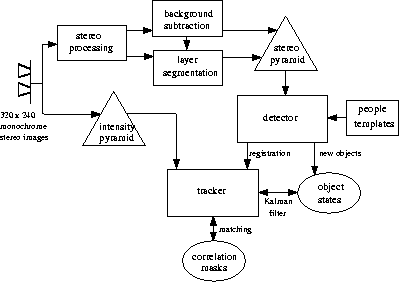
The system architecture, shown in Fig. 1,
exhibits a tight coupling between the tracker and a
continuously-operating detector. Information from a monochrome stereo
head is fed into a stereo processing unit, which performs efficient
area-based correlation to extract disparity information [14]
at some cyclical rate, typically greater than 10 Hz. A further
operation of background subtraction isolates objects that differ from
a learned background. This information is fed to a recursive
segmentation process, and the results are scaled at different
resolutions in the stereo pyramid. Pyramid representations are used
to compensate for scale differences, and to increase the efficiency of
processing for certain operations.
A detector, running at each cycle on all levels of the pyramid, matches an appropriate shape model template to detect person-like objects. Detection is used in two ways: to find new people and insert them into the current state; and to register tracking templates that are following already-detected people.
The tracker utilizes intensity information, again with a pyramid structure to help with scale changes. As new people are found and presented to the tracker, it forms an adaptive tracking template for the person. At each cycle, it updates their state using a Kalman filter and information obtained by correlation of the tracking template. The tracker relies on the detector to compensate for drift as it adapts the tracking templates. Additionally, the tracker will eliminate people from the set of states if they are no longer recognized in the scene.
There are a few limitations of the system. Because we rely on range background subtraction, the camera cannot translate, although rotations and zooming can be accommodated [5]. Surprisingly, the system is not severely limited by the decrease of depth resolution with distance, even for small stereo baselines. For example, we are able to use stereo effectively at 20 m, with a baseline of only 11 cm; the excellent stability of background subtraction accounts for this.
In the next few sections we give detailed descriptions of the detection and tracking algorithms.
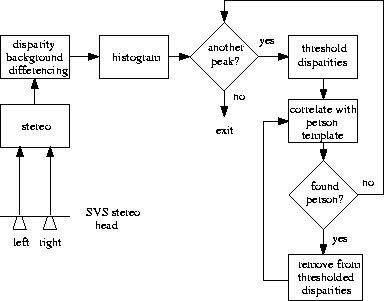
The goal of the person detection module is to automatically initialize person tracks for the tracker. The main idea behind the detection module is to segment the foreground image into layers of near constant disparity. People are then located within these layers by correlating with a bank of person templates. The main steps in our person detection module are shown in Fig. 2.
Given a left and right image pair from a stereo head, we first compute
stereo using the area correlation method described in [14].
The disparity image is a dense image slightly smaller than the
original intensity image, where the disparity is inversely related to
depth according to the formula
In order to detect foreground objects in the scene, background differencing is applied to the stereo disparities [5]. While stereo involves some computational expense over using color or intensities, it does offer some advantages. First, stereo disparities are insensitive to shadows and changes in lighting conditions. Second, for two people who are adjacent in the image but at differing depths, their differing disparities will allow the system to properly segment the two. In our backgrounding computation, pixels that have a larger disparity than the background (i.e. closer to the camera) are initially marked as foreground. The morphological opening operator (erode followed by dilate) is applied to suppress noise and connected components are computed to retain blobs of a minimum size.
In our system, the background disparity image is computed by averaging the stereo results from an initial background learning stage where the scene is assumed to contain no people. While much work has been done on adaptive background models [5,8], the insensitivity of stereo to changes in lighting mitigates to some extent the need for adaptation. We plan to add adaptation to deal with long-range changes such as adding/subtracting objects from the scene.
Next, the foreground disparity image is further segmented into layers
of dominant disparity. This takes advantage of stereo's ability to
segment objects at different depths. A histogram of the foreground
disparities is computed, smoothed, and then histogram peaks are
extracted as seeds for forming layers. When focusing attention on
a particular layer, we gate the foreground disparities in a
disparity-dependent range around the histogram peak.
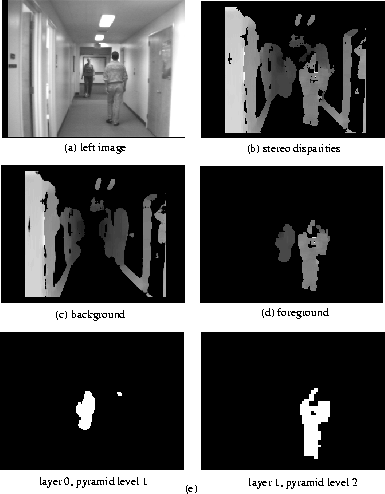
Fig. 3 shows (a) the left image from a stereo pair,
(b) the stereo disparities, (c) the background disparities, (d) the
foreground disparities, and (e) the two foreground layers.
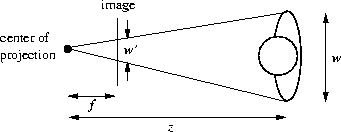
In person finding systems that utilize no range information, image scale is an important issue. Detecting people at a range of scales typically involves search over that range (e.g. [16]) or estimation of scale from segmented blobs, which is difficult. Stereo disparity information allows us to compute the appropriate scale from a layer's dominant disparity directly. In fact, person scale is proportional to disparity.
Consider a person with width w standing a distance z from the camera
as shown in Fig. 4. The person projects to a width w' in

 .
Combining with Equation (1) to eliminate z, we get
.
Combining with Equation (1) to eliminate z, we get
Since we want to operate on a large range of scales (scale change of
10:1) in real time, the detection and tracking modules operate on a 4
level pyramid. Stereo and background subtraction are performed at the
highest level, but as soon as we focus on processing a layer at
disparity d0, we switch processing to
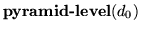 ,
where the pyramid level is chosen to make the
expected person width 8 pixels (using Equation (2)). This
keeps our person templates for detection and tracking to about 12x28
pixels, which is important for speed.
,
where the pyramid level is chosen to make the
expected person width 8 pixels (using Equation (2)). This
keeps our person templates for detection and tracking to about 12x28
pixels, which is important for speed.
Given disparity layers capturing foreground objects at different disparities, the next step is to detect the people present in the foreground layers. This is done using correlation with binary person templates. Notice that we are doing binary correlation so the templates simply capture the 2D shape of people. As compared to, say, intensity-based appearance modeling (e.g. eigenfaces [24]), there is much less variation in the coarse 2D shape of people, especially when one operates at lower pyramid resolutions. Thus, we use a simple person model based on a small set of binary templates.
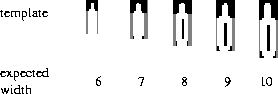
Shown in Fig. 5, the set of binary person
templates used for detection differ from one another primarily in
scale. These templates are designed to cover the expected scale
variation in one octave of our pyramid representation. More
precisely, given a foreground layer at disparity d0, we downsample
the later to pyramid level
.
Using
Equation (2), we predict the expected width of the
person and hence which template from Fig. 5
to correlate with.
 |
The selected person template is then correlated against the downsampled layer image, using a Hamming distance metric. If the maximum correlation value is above a threshold, then we place a new person detection at the location of the correlation peak. The threshold we use for detection is approximately 75% of the number of template pixels. Since there might be multiple people present in the foreground layer, the detected person is subtracted from the layer and the correlation process repeated. In the flowchart of Fig. 2, this loop shows up in the three boxes in the lower right. Naturally, when no additional people are detected at the current disparity layer, the next disparity layer from the disparity histogram is processed.
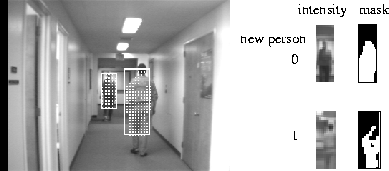
Person detections for the image in Fig. 3 are shown in Fig. 6. When a person is detected - and hence initialized for the tracker - two templates are extracted:
 |
Over the last few years, multiple hypothesis trackers have emerged as a technique for dealing with clutter and occlusion [11,21,18,3]. In an ambiguous clutter or occlusion related event, the probability distribution spreads out and becomes multimodal, essentially allowing the tracker to maintain multiple tracking solutions. As the sequence evolves and the tracking becomes less ambiguous, the probability distribution ideally becomes unimodal again around the true answer.
Our tracker is multimodal in a different way, using multiple input modalities, namely intensities and stereo disparities (see also [4,10]). While it is unimodal in terms of tracker state for an individual, it takes advantage of the segmentation aspects of stereo to achieve some of the same results as probabilistic trackers. Background clutter can be ignored by using predicted disparities to narrow search to a particular foreground disparity layer. Another advantage of using stereo is that template drift, a problem for adaptive templates, can be avoided by using the segmentation information.
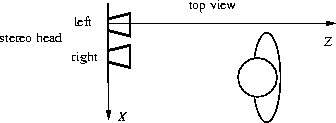
Our tracker works in a Kalman filter [7] framework where the
measurement process is intensity correlation and stereo. To measure
person location, we use a world coordinate system (X, Z) as shown in
Fig. 7, where the X-Z plane is parallel to the floor
and Z measures the distance from the stereo head. This world
coordinate system is preferable to an image-based
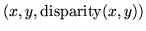 since our constant velocity model for system
dynamics is more appropriate for the world coordinate system (i.e. people actually move about in the world coordinate system). It is
easy to map back and forth between world and image coordinates.
Assuming that the stereo head is parallel to the floor, Z is
related to
since our constant velocity model for system
dynamics is more appropriate for the world coordinate system (i.e. people actually move about in the world coordinate system). It is
easy to map back and forth between world and image coordinates.
Assuming that the stereo head is parallel to the floor, Z is
related to
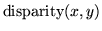 using Equation (1)
and x is related to X using the familiar perspective projection
equation x = fX/Z.
using Equation (1)
and x is related to X using the familiar perspective projection
equation x = fX/Z.
Our Kalman filter state is a vector
 ,
and
our model for system dynamics is a constant velocity model;
acceleration is modeled as noise. In the description of the tracking
algorithm below, d is the depth Z mapped into image space as a
disparity value. The image measurement y is also maintained for
each person outside of the Kalman state; the variance on this
measurement is so high we felt that it might detract from the filter
performance if included.
,
and
our model for system dynamics is a constant velocity model;
acceleration is modeled as noise. In the description of the tracking
algorithm below, d is the depth Z mapped into image space as a
disparity value. The image measurement y is also maintained for
each person outside of the Kalman state; the variance on this
measurement is so high we felt that it might detract from the filter
performance if included.
In this section we give the details of the tracking algorithm. This procedure is iterated, of course, over all the people being tracked by the system. The primary novel feature here is how stereo is being used to modulate the intensity correlation and re-center the templates to avoid drift. We assume that stereo and disparity background subtraction have already been applied to the image. For the person P being tracked, let Ptempl be the intensity template and Pmask be the stereo mask (as in Fig. 6).
tracking procedure
input: image intensities Ileft
		 stereo foreground Ifgnd
		 person P to track
algorithm:
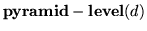 .
Each pixel in Ptempl is weighted by Pmask, which eliminates
the influence of background clutter from the template.
.
Each pixel in Ptempl is weighted by Pmask, which eliminates
the influence of background clutter from the template. Steps (1), (3), and (5) constitute a fairly standard correlation-based Kalman filter. Our stereo enhancements are in steps (2) and (4). Step (3) does most of the work in updating the person position, but is susceptible to template drift. Step (4) emphasizes depth discontinuity information to try to keep the templates centered. Notice also in step (3) how the stereo mask is used to focus attention on the foreground object pixels in the template.
In the recursive update step (5), the template Ptempl is
updated using the formula

 is 0.75.
The mask Pmask is updated in the same way. Also, disparity d is updated
as follows:
is 0.75.
The mask Pmask is updated in the same way. Also, disparity d is updated
as follows:

In our detection and tracking system, new people are always being
added by the detection module. Likewise, the tracker needs a
criterion for eliminating people who have been occluded. When a
person A is occluded, A will no longer claim portions of the
foreground disparity map, so A's probability mask Pmask will
trend down to zero. Thus, the tracker eliminates a person when

In terms of tracking multiple people, we have found that sorting and processing people from front to back helps with occlusion events. If person B hides behind person A, the algorithm will update Abefore B, which helps maintain the continuity of A. Since person A ``claims'' the disparities from the foreground image Ifgnd as B disappears, B will lose support and will be properly eliminated by the tracker.
In this section we show plots of some tracking results; a quantitative
evaluation of the detection and tracking modules is given in section 7.
First, Fig. 8 shows two separate tracks for a
single person. The upper sequence, a sequence where the person runs
up and down a hallway, demonstrates two nice features of our tracker:
(1) we can track out to 20 meters from the stereo head with a camera
baseline of only 11 cm, and (2) the tracker can keep up with a
running person. In the lower track, the person is walking in a
figure eight pattern.
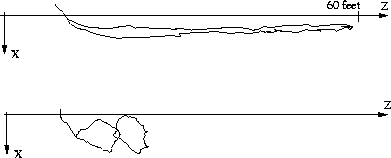 |
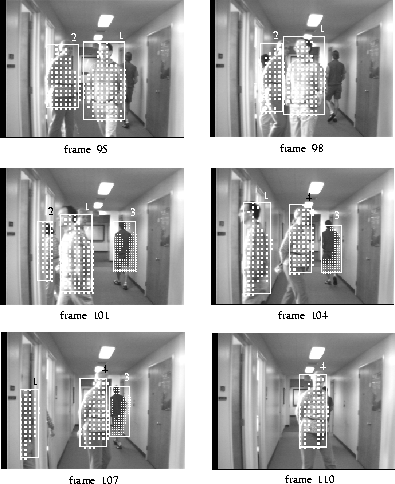
Fig. 9 demonstrates the system's ability to track
multiple people. The figure shows six frames covering approximately 2
seconds from sequence of four people, three of whom are visible at any
one moment. Person ID's are indicated in the upper right corner of
a tracking box. Person 1 is correctly tracked, but person 2 is
temporarily occluded by person 1 and then redetected as person 4 in
frame 104.
 |
Our tracker runs on standard PC hardware, a dual Pentium II processor at 400 MHz. In terms of distributing the computational load across both processors, we have placed the stereo computation on one and the stereo backgrounding, detection and tracking modules on the other. The processors are arranged in a software pipeline, with the currently captured video frame first being processed for stereo. Then on the next frame, frame F+1, stereo processes frame F+1 while the backgrounding/detection/tracking processor handles frame F. This introduces one frame of latency in processing, but allows for a simple division of the whole algorithm across both processors.
In the stereo module, we use SRI's Small Vision System [14], a stereo system that is inexpensive, has low power consumption, and is available to researchers through SRI and Videre Design. The left and right images are captured using two CMOS cameras that are mounted on a custom circuit board using pluggable mounts so that the baseline is adjustable. The stereo computation, which is performed on one of the Pentium processors, is area correlation based and is coded using optimized C and MMX code. On a 320x240 image, the stereo computation using a disparity window of 24 pixels runs at around 20 Hz.
The detection and tracking modules obtain real-time performance by performing their image processing on a image pyramids. As mentioned in section 4.2 on handling scale, the pyramid level is chosen using the person disparity to keep the templates at a reasonable size for the correlation routines. Overall system performance is as follows: when tracking no people (stereo and detection processes only), the system runs at 20 Hz. When tracking one person, performance goes down to 15 Hz, and with four or five people performance drops to around 8 Hz. When tracking multiple people, the backgrounding/detection/tracking processor is the bottleneck. For load balancing purposes, some more of the algorithm should be shifted to the stereo processor. As faster processors become available, one could choose among tracking more people and/or increasing the resolution of the templates used for tracking (i.e. moving to a higher resolution level of the pyramid for a given disparity).
In this section, we describe our experimental setup and quantitatively evaluate the our tracker on several sequences.
The stereo head, configured with a camera baseline of 11 cm and a FOV of 50 degrees, is aimed down a corridor in our office building; Fig. 3 shows a typical view. The hallway extends 60 feet before reaching a wall, and we have tracked out the full 60 feet as shown in Fig. 8. At the end of its range, we are seeing disparity differences from the background of less than 1/2 pixel, showing the excellent background discrimination and the ability of stereo to work at far distances. When capturing sequences, we asked people to walk up and down the hall and in and out of offices.
To evaluate the tracker, we compiled statistics related to person detection, tracking, and false positives. To this end, we first collected a number of test sequences and manually defined ground truth for each sequence by specifying the center of the torso section of each person in every other frame. Then, to evaluate a sequence, we run the tracker and match up the resulting tracks with ground truth. This matching process follows a simple greedy algorithm: compute all distances between tracker centroids and ground truth, pair up the track and ground truth with smallest distance, and repeat until the smallest distance is above a threshold of about 75% of body width. Distances, of course, are normalized using disparity information from the tracker and Equation 2.
Given these matches, the tracking rate is defined as the percentage of all ground truths that have corresponding matches from the tracker. Likewise, the false positive rate is defined as the portion of tracks that have no corresponding ground truth. To evaluate the detection module, we measure the mean time to detect. This is the mean number of frames from the first appearance of a ground truth to the time it is detected by the tracker. Since occlusion occurs frequently in our sequences, the mean time to detect also includes the time taken to reacquire ground truths after they have re-emerged from being occluded.
Table 1 shows the tracking rate TR, false positive
rate FP, and mean time to detect MTD for a set of sequences. Each
sequence contains between 200 to 300 frames and covers roughly 10 to
20 seconds.
The sequences are ordered roughly from easiest to most difficult,
where difficulty is measured by the number of people in the sequence
 and the number of occlusion events in the sequence
 .
.
To evaluate the usefulness of adding the modality of stereo to the tracker, we ran the tracker with the recentering step (4) disabled and with using normal correlation in step (3) instead of weighted correlation. We noticed much more template drift, and the mean tracking rate decreased 4% (people tended to be redetected right after the template drifted off). The mean false positive rate increased significantly - from 3% to 10% - since the tracking often double-tracks a person during drift.
In recent years the tracking community has started to emphasize tracking in the face of background clutter and partial occlusion. We have explored how to use stereo in a multimodal approach to the person tracking problem, demonstrating a detection and tracking system that runs in real time on standard PC hardware. The detection module uses stereo to segment a foreground image into layers containing people. People are then localized in these layers by correlating with a bank of person templates. The detected people are tracked using correlation on intensity templates with adjustments from stereo detection to avoid template drift. We have demonstrated the system tracking multiple people in real time while handling a large number of occlusion events.
For our future directions, the most important remaining tracking issue is that of redetection when a person is temporarily occluded. In the current system, the person is detected as a new track when this happens. Our system needs to store distinguishing features of the person, perhaps color, that would enable recognizing a person after occlusion. Also, we hope to have a add color and motion to the input modalities used for tracking - a color version of the Small Vision System will be available shortly. Finally, more detailed person models should be explored, but they will have to fit into our real time constraints.
This document was generated using the LaTeX2HTML translator Version 98.1p1 release (March 2nd, 1998)
Copyright © 1993, 1994, 1995, 1996, 1997, Nikos Drakos, Computer Based Learning Unit, University of Leeds.
The command line arguments were:
latex2html -split 0 -show_section_numbers iccv99.tex.
The translation was initiated by on 1999-08-27